Urbex: Car Graveyard, France – September 2015
Hidden deep within a dense thicket of French woodland lies a silent congregation of steel and glass. This “car graveyard,” discovered during a trip in September 2015, is a testament to the power of nature’s reclamation. Despite having exact coordinates, the site was so thoroughly swallowed by the undergrowth that I walked past it twice before the glint of oxidised chrome caught my eye.
The scene was surreal. Decades of leaf mulch and moss have created a soft carpet around vehicles that once roared through the French countryside. It is difficult to conceive how these cars, some dating back to the pre-war era, were navigated through these narrow trees, or why they were left here to begin with.
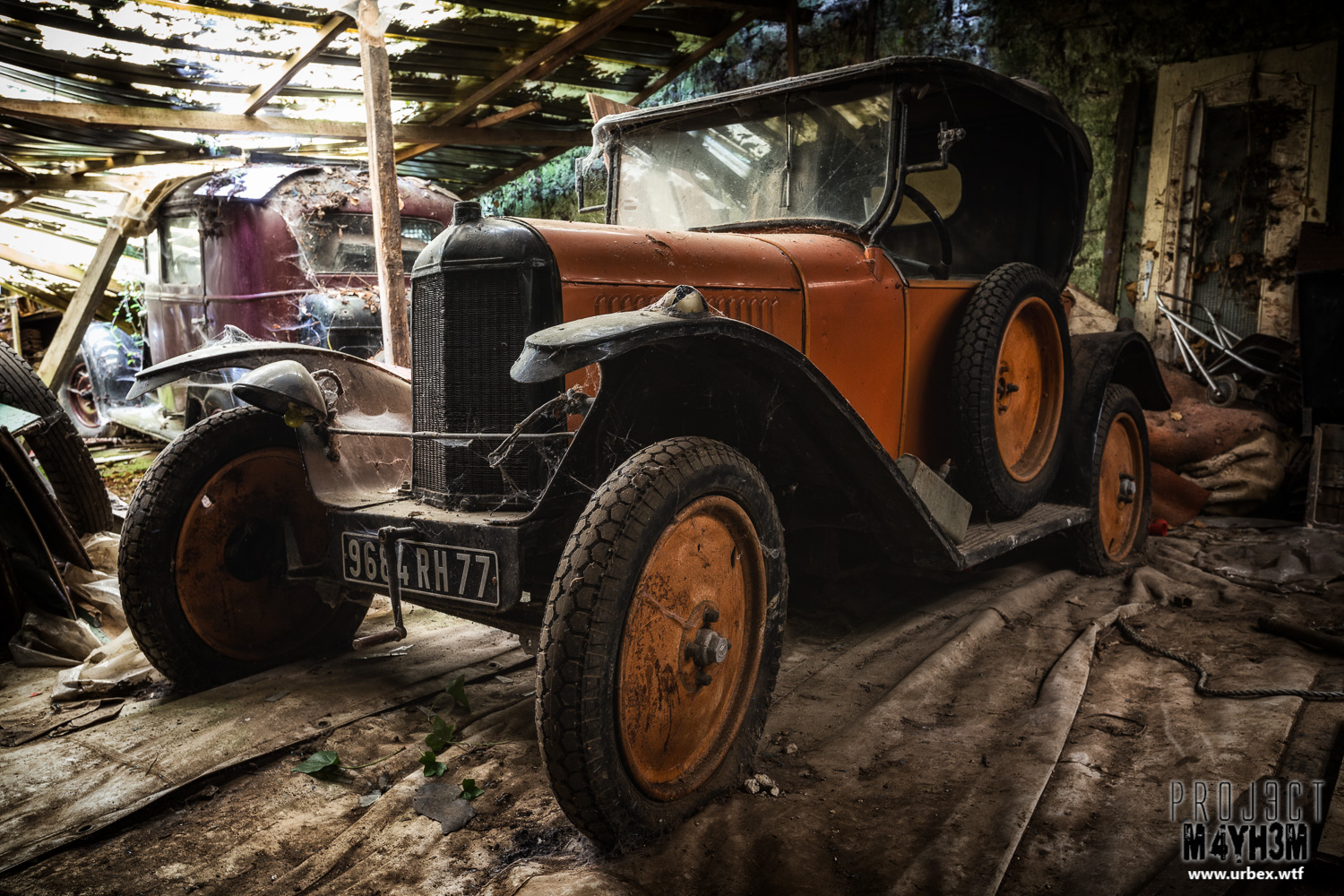
The condition of the fleet varies wildly. Some skeletons are little more than rusted frames surrendered to the damp earth, while others remain surprisingly intact, their curves still holding the elegance of 1930s and 40s design. One of the most striking details was the discovery of hand-painted number plates on the older models, a personal touch from a bygone era of motoring.
As the forest slowly digests these machines, they transform from transport into art. Every cracked headlight and moss-covered steering wheel tells a story of a journey that ended in this quiet, leafy sanctuary.
A list of what I’ve been able to identify of the vehicle, mostly with the help from readers of this article… if I have got any of them wrong, please let me know in the comments below 🙂
1. Citroën 5HP (Cloverleaf / Trèfle)
- Era: Mid-1920s.
- Details: Often called the “Cloverleaf” because of its unique three-seat arrangement (one in the back centred between the two front seats). It was one of the first mass-produced European cars and was designed to be easy for novices to drive.
2. Citroën Rosalie
- Era: Early to mid-1930s.
- Details: These were robust, upright sedans. They were famous for their durability and for breaking several long-distance speed records at the time. You can identify them by their distinctively tall, vertical radiators.
3. Renault NN (6CV)
- Era: Late 1920s.
- Details: A direct competitor to the Citroën 5HP. The “NN” is easily recognisable by its “shovel-nose” hood—Renaults of this era didn’t have a front radiator grill because the radiator was located behind the engine.
4. Simca 5
- Era: Late 1930s to late 1940s.
- Details: This was essentially a French-built version of the Fiat 500 “Topolino.” It is a tiny, rounded car that helped motorise France before and after WWII. Its small size makes it look particularly “tucked away” in the forest.
5. Citroën Type H (The “Tube”)
- Era: 1947–1981.
- Details: You mentioned a “Tube Citroën.” This is the iconic corrugated metal van. Even in a graveyard, its boxy, industrial shape is unmistakable. These were the workhorses of French markets and police for decades.
Why are they there?
In rural France, it was historically common for farmers to park retired vehicles in a corner of their woods. Before modern scrap-metal regulations, these “graveyards” served as a source of spare parts for other vehicles on the farm. Over time, the parts were salvaged, the owners moved on, and the forest grew up around what remained.


If you’ve made it this far… thanks for reading / checking out the pictures. Leave me a comment below or hit the like button to let me know you’ve enjoyed the shots and to encourage me to keep posting more 🙂
Limited Edition prints and Canvases, as well as regular prints, are available for all of the images above on request and visit the store for more prints and products.

Related posts:
 Urbex: Car Graveyard 2, France – September 2017
 Urbex: The Cavern of the Lost Souls aka The Car Graveyard Mine, Wales, United Kingdom (revisit)- September 2015
 Urbex: Aircraft Graveyard, France – September 2015
 Urbex: Pensionnat de Chavagne, France – September 2017
 Urbex: Le Château de Lesches, France – September 2015
 Urbex: Château Gryffindor, France – September 2015
 Urbex: Château Verdure, France – September 2015
 Urbex: Château Fachos, France – September 2015
 Urbex: Château de la Musique, France – September 2015
 Urbex: Chateau Chimera, France – September 2017